
I. Observation Distance
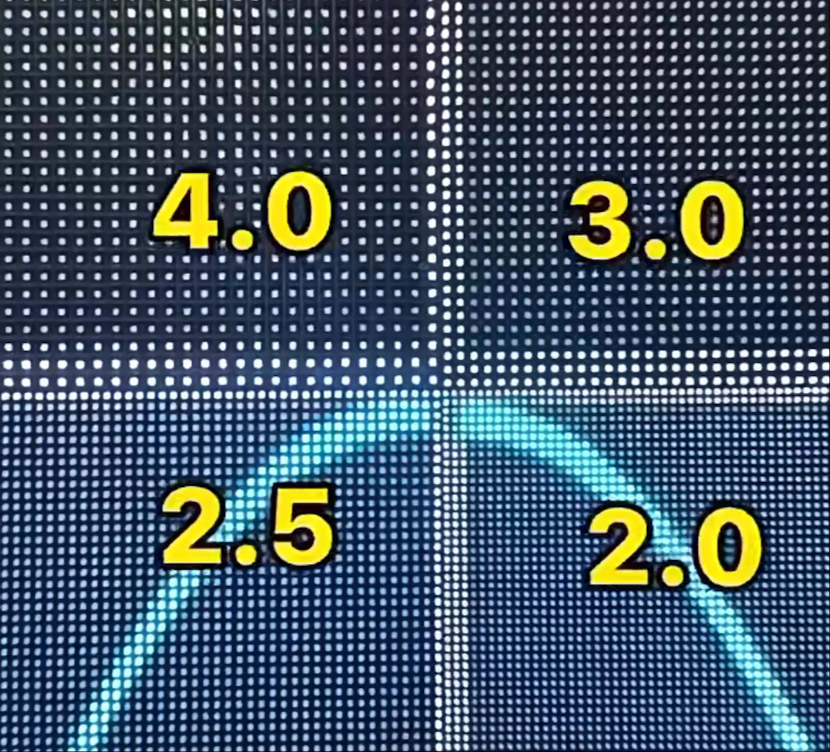
Small pixel pitch is suitable for close viewing distances and provides a detailed image; large pixel pitch is suitable for longer viewing distances and is more affordable.
Recommendations:
Viewing distance < 1m: Use < P1.2 Viewing distance 1.5m: Use < P1.5 or P1.8 Viewing distance within 2m: Use < P2.0 or P1.8 For indoor use beyond 2 meters, P2.5 is recommended and offers the best value for money. Other options like P3, P4, etc., are no longer mainstream products in the industry. (P4 is the most common choice for outdoor use)
II. Uses
户外显示屏需高亮度和防护等级,室内显示屏注重色彩和对比度。
Have you noticed that LED screens of the same size always cost significantly more for outdoor use than for indoor use? There are actually many “hidden advantages” behind this! Today, let’s break it down for you in simple terms with a little bit of science! 1. [Outdoor-exclusive “protective shield”?] Outdoor screens face wind, sun, rain, and even insects and dust! Therefore, the casing must be “waterproof and durable,” generally reaching IP65 waterproof rating (resistant to splashing and short-term immersion). The frame uses thickened aluminum alloy with an anti-corrosion coating, and the module gaps are also sealed. Indoor screens, on the other hand, comfortably stay in air-conditioned rooms, so ordinary materials are sufficient, naturally resulting in lower costs. 2. [Brightness pushed to the limit, cooling working overtime!] The outdoor sunlight is so strong that a screen that isn’t bright enough is simply unreadable! Therefore, the brightness of outdoor screens is maximized—generally above 3000 cd/m² (clearly visible even in the midday sun). High-brightness chips are inherently more expensive. And high brightness easily generates heat, requiring a “mini air conditioner”: built-in fans, large heat sinks, and even water cooling designs! Indoor screens only need 800-1500 cd/m² of brightness, and natural ventilation is sufficient for cooling, saving a lot of money.
[Hidden skills: anti-interference + temperature resistance] The outdoor environment is too complex! Lightning and signals from nearby equipment can interfere with the display, so lightning protection and electromagnetic interference protection designs are necessary; in winter, temperatures can drop to tens of degrees below zero, and in summer, they can reach over 60°C, so the screen must withstand the extreme temperature differences.
Indoor screens: I just need to quietly emit light! In summary:
Outdoor screens = “Outdoor special forces” wearing waterproof suits, sun hats, and carrying radiators. Indoor screens = “Good boys” wearing home clothes. With such a difference in functions and equipment, the price is naturally different! What other little-known facts about LED screens would you like to know? Tell me in the comments!~
III. Dimensions
The screen size should be determined based on the installation location and requirements. The screen resolution and aspect ratio of the displayed content should also be considered. For example, “P2” in LED displays means a pixel pitch of 2mm. If your screen is 3 meters wide and 2 meters high, the resolution would be 3000/2 = 1500 pixels horizontally and 2000/2 = 1000 pixels vertically. Therefore, the resulting resolution would be 1500 x 1000 pixels.
IV. Budget
LED displays of different specifications vary significantly in price, so you should choose one based on your budget. However, don’t just focus on the price; quality and performance are equally important. The best value for money is the P2.5 display; if you have a higher budget, you can choose a smaller pixel pitch, as a smaller pixel pitch results in a finer image.