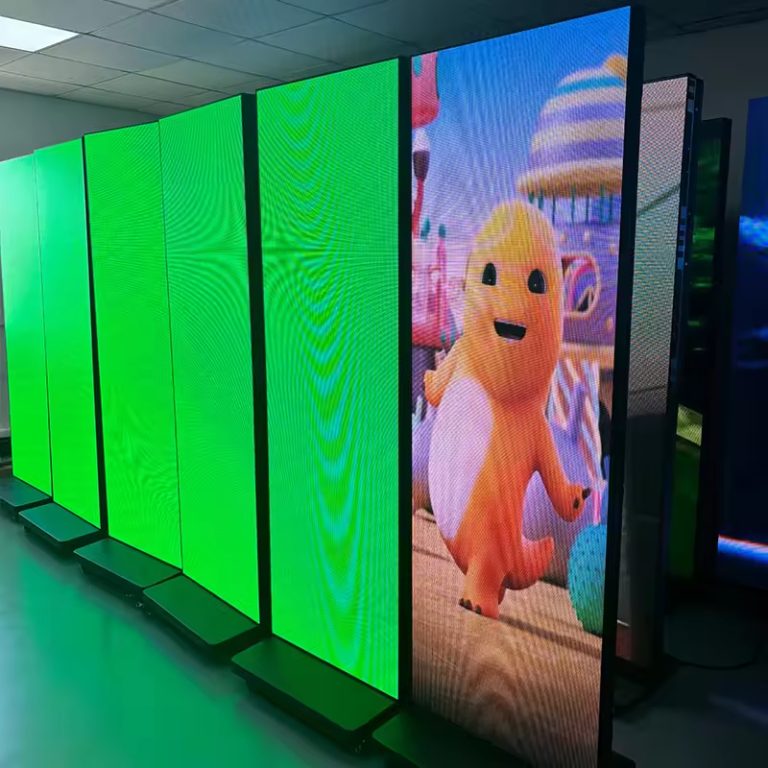
How can we ensure image clarity?
LED large screens are not available in arbitrary sizes; the appropriate specifications need to be selected based on different usage scenarios. Generally, the height of the large screen is chosen between 3-4 meters, depending on the budget and the desired visual effect.
What does “P” in a large screen refer to?
It refers to the pixel pitch. A complete LED display screen is composed of many LED beads, and there is a certain distance between each LED bead. This distance varies from 1.25mm to 20mm. The “P” value of an LED display screen describes the distance between the centers of two adjacent LED beads, in millimeters. The smaller the pixel pitch, the higher the density, and the better the clarity for the same screen size. What size should the screen be?
The size depends on several factors, including the number of viewers and viewing distance, venue space and layout, content display requirements, and budget constraints.
Venue space and audience size
After determining the placement of the LED screen, measure the available space dimensions, including width, height, and depth. Sufficient space must be left behind the screen for maintenance and the placement of counterweights. For large audiences, a larger LED screen should be chosen to ensure that all viewers can clearly see the content displayed on the screen.。
Viewing distance and content
It’s necessary to consider both the nearest and furthest viewing distances. With a fixed viewing distance, different pixel densities will produce different results. Higher density generally leads to a clearer image, but if the source material doesn’t match the resolution, a lower density might actually produce a better result.
Common resolution pixel densities:
1080p: 2,073,600 pixels per square unit
2K: 3,686,400 pixels per square unit
4K: 8,294,400 pixels per square unit
8K: 33,177,600 pixels per square unit
What power supply capacity is needed?
The approximate power consumption is estimated based on factors such as screen size, pixel density, brightness, and ambient temperature. Indoor screens typically consume less power, while outdoor LED screens usually consume more power because they require a brighter display to counteract sunlight.
Power consumption per square unit at different pixel densities.
The power consumption per square meter of an LED display is affected by several factors, including pixel density, brightness, screen size, and operating conditions. Generally, higher pixel density results in higher power consumption per square meter because more LED beads are needed to create a higher-resolution screen. However, the exact power consumption depends on the specific LED display model and manufacturer. Generally, the power consumption per square meter of an LED display can range from tens of watts to several hundred watts. Here are some general estimates:
P10 to P20 LED displays typically consume approximately 50 to 200 watts per square meter.
P6 to P8 LED displays typically consume approximately 200 to 400 watts per square meter.
P3 to P5 LED displays typically consume approximately 400 to 800 watts per square meter.